Buyers often ask which materials make a good roller shutter. A higher price usually means better raw material, but a better material does not guarantee a better door. What counts is the manufacturer’s quality control during production and installation. Pick an electric roller shutter that fits your actual requirements. More expensive is not always better.
Two main shutter fabric groups
Today’s shutter fabrics fall into two groups: polyester fiber wrapped in PVC, and glass fiber wrapped in PVC. Both share one technical measure of light transmission: the mesh opening rate. That is the share of the fabric taken up by holes, per unit area. Fabrics usually come in 1%, 3%, 5%, 8%, or 10% mesh opening rates for different places and functions.
Installed indoors, a darker fabric of the same mesh rate transmits light and view better; a lighter fabric does the opposite. Used outdoors, a fabric with an aluminum coating or a darker color works better, because the coated fabric reflects more heat and the dark fabric absorbs more.
Pick your electric roller shutter material by use case
The common roller shutter material options you will see on a spec sheet are grid, color steel, aluminum alloy, stainless steel, PVC, and crystal.
- Aluminum alloy roller shutter — The common and traditional type. Strong on looks and eco-friendliness, but its main drawback is noise.
- Color steel roller shutter — Comes in a range of colors. You can choose different panel thicknesses and add window panels or a pass door.
- Grid roller shutter — Breathable and light-transmitting while still theft-resistant. Very modern looking.
- Crystal roller shutter — Made with PC bulletproof-glue crystal slats. Widely used in clothing malls. Very stylish.
- PVC roller shutter — Made from PVC, as the name says. Blocks dust fast and effectively, with strong insulation, warmth retention, and soundproofing.
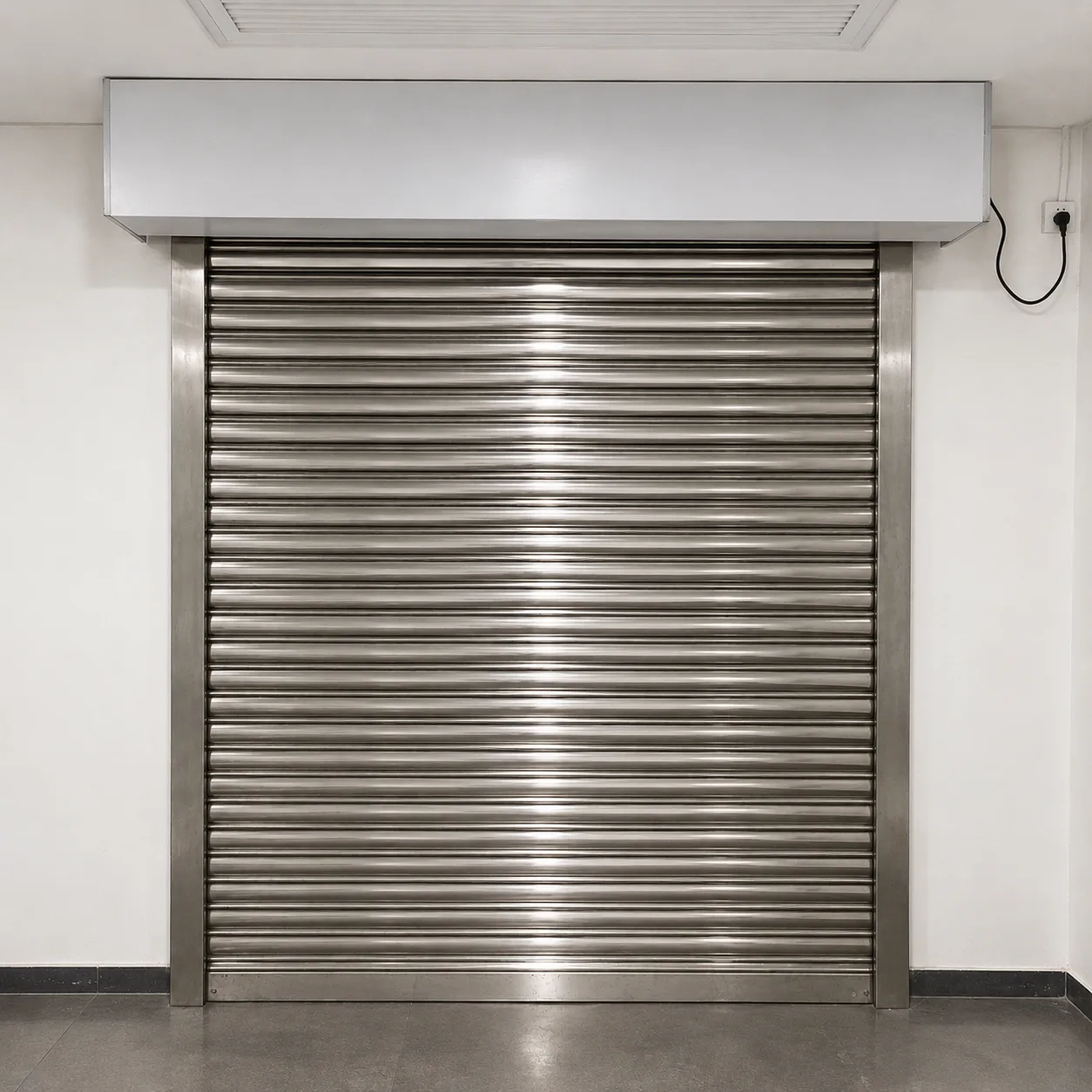
- Stainless steel roller shutter — Panels made of stainless steel. Glossy surface that resists wear and scratches.
- Fire rated roller shutter — Built for fire and heat isolation at large building openings. The design and installation play a real technical role. Fire rated shutters are used widely in industrial and civil buildings as fire compartments. They stop fire from spreading and protect life and property. They are a necessary fire safety feature in modern buildings.
Fire rated shutter types
The main types of fire rated roller shutter are: composite steel fire shutter (fire and smoke resistant), inorganic premium fire shutter (twin-track, twin-curtain), premium steel water-mist fire shutter, steel composite side-mounted fire shutter, steel composite horizontal fire shutter, inorganic premium folding fire shutter, and various types with pass doors in the curtain.
Among all these materials, fire rated shutter material is the standard choice in building fire safety. Different materials give different shutter styles and fire ratings. RHIDOOR laid out this material list for customers as a reference. We believe you will find the right shutter for your site. To learn more about roller shutters, follow the RHIDOOR website.
Ready to narrow it down? Learn how to pick the right roller shutter material with our step-by-step view. When you know the curtain, browse our roller shutters to see it built.
Related Articles
- Which Material Is Best for Electric Roller Shutters?
- Material Knowledge and Function to Know Before Buying a Fire Rated Roller Shutter
- How to Pick the Right Roller Shutter Material
- Fire Rated Roller Shutter Quality and Where to Install
You don’t need a big order to move fast — we take orders from 1 pc and ship within 15 days, every time.
Ready to upgrade your facility? Let our experts help you find the perfect RHIDOOR solution for your application. Contact Us Today

