Most buyers do not have a “door problem.” They have a throughput, security, or climate problem that a door happens to solve. Pick the door by its label — “just get a roller shutter” — and you end up with a shutter that is too slow for your dock, too opaque for your storefront, or too heavy for your frame. This guide fixes that by starting from the problem and working back to the product.
An industrial door or roller shutter is any powered or manual closure built for commercial and industrial openings — from a high-speed PVC door that opens 1–2 m/s to keep a clean room sealed, to a transparent crystal shutter that protects a mall storefront while showing the merchandise, to an aluminum or steel roller shutter for shops and garages, and a sectional garage door for vehicles. The right one is chosen by traffic speed, visibility, security level, and budget — not by habit.
This is the hub page for RHIDOOR’s non-fire-rated range. Use it to narrow your shortlist, then follow the internal links to the deep-dives on each door type, material, and cost.
Key takeaways
– High-speed doors (PVC, 0.6–2.0 m/s) solve traffic and climate separation; they are not security doors.
– Crystal (transparent) shutters give retail security with visibility — ideal for malls and flagship stores.
– Aluminum shutters are light, corrosion-resistant, and quiet; steel shutters are stronger and cheaper but heavier.
– Garage / sectional doors are for vehicle access and insulation, not foot traffic or fire rating.
– Budget by lifecycle, not sticker price: RHIDOOR’s 1-piece MOQ, 15-day lead, and 200+ RAL colors change the math for small batches and retrofits.
Start With the Problem, Not the Product
Before you read a single spec, answer four questions. They eliminate 80% of options immediately:
- How fast does traffic move? Forklifts every minute → high-speed door. Occasional foot traffic → a standard shutter is fine.
- What must you see through it? Display stock or a reception desk → transparent or perforated.
- What are you protecting against? Theft → steel or aluminum. Weather/cleanliness → insulated or high-speed.
- What is the opening and structure? A wide, load-limited frame rules out heavy steel.
Our industrial roller shutter types & advantages article lays the full taxonomy out. And if you only remember one thing: high-speed vs ordinary roller shutters is the single most common mix-up.
High-Speed Doors
High-speed doors open and close at 0.6–2.0 m/s, slashing the time an opening is exposed. They are the workhorse of clean rooms, cold stores, and busy docks.
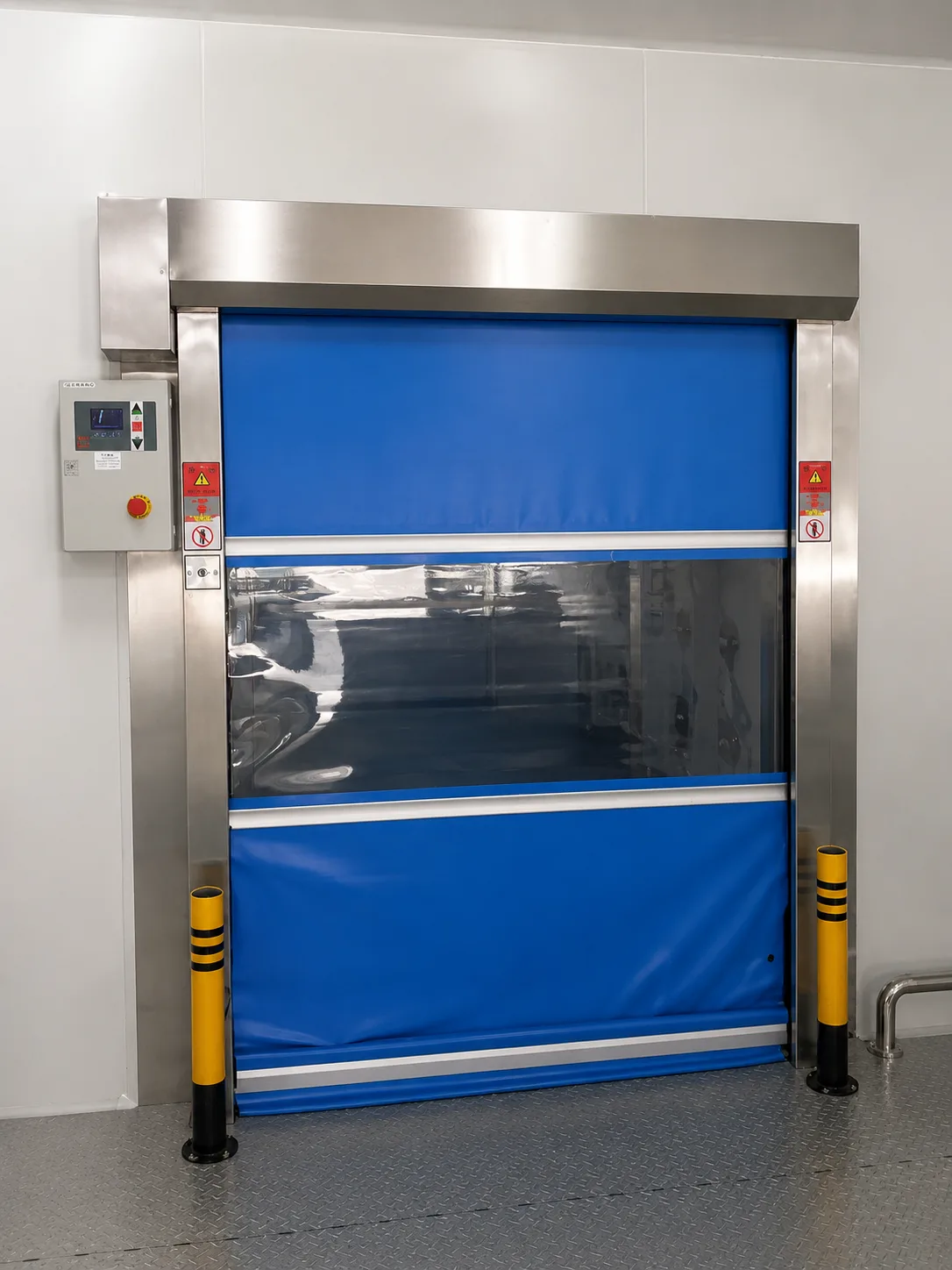
Where they win:
– Clean rooms & food plants — keep dust, insects, and temperature out (wind-resistant high-speed roller shutter advantages).
– Logistics & docks — move goods without the door becoming the bottleneck.
– Cold chains — a fast close limits temperature loss.
Four control methods — radar, loop, remote, and pull-cord — are compared in four control methods for high-speed roller shutters.
Story: A contract packer in Laguna, Philippines, ran a single PVC high-speed door on his busiest dock. During peak season it stuck open for 40 minutes after a sensor fault, and the clean-room pressure dropped. Output stalled. RHIDOOR supplied a second door as a redundant lane plus a fail-safe that auto-closes on sensor loss. Throughput on bad days went from “stopped” to “slowed.” The second door cost less than one day of lost production.

High-Speed Stacking & Spiral Doors
When the opening is tall or the traffic is constant, a standard rolled high-speed door starts to struggle. That is where stacking (vertical-lifting) doors come in: instead of winding onto a small barrel, the curtain folds into horizontal sections and stacks above the opening, so a 5-metre door opens just as fast as a 2-metre one. They suit cold stores, clean rooms, and busy docks where a rolled curtain would be too heavy or too slow to cycle reliably.
For sites with tight side room or a curved approach — pharma labs, food lines, tight loading bays — a spiral door wraps the curtain around a rigid spiral, protecting the PVC from abrasion and stretching its service life. Both types share the same control logic as a standard high-speed door, so your operators and maintenance team learn one system and carry one spare-parts list.
Story: A dairy plant in Lahore ran a rolled high-speed door on a 4.5-metre cold-store opening. In summer the PVC stretched, the door drifted off its tracks weekly, and every misfire bled cold air into the dispatch area. RHIDOOR swapped it for a stacking door sized to the full height. The track issues stopped, and the energy logger showed a measurable drop in compressor runtime. The plant manager’s note back to us: “the door finally disappeared from my weekly problem list.”
Crystal (Transparent) Roller Shutters
A crystal shutter uses clear polycarbonate or acrylic slats in an aluminum frame. It locks like a roller shutter but lets light and merchandise show through — which is why malls and flagship retailers love it.
Best for: jewelry stores, mall kiosks, pharmacies, and any frontage where you want the window lit at night but secured.
Watch-outs: transparent slats scratch more easily than steel, and they are a visibility product first, a brute-force product second. Pair with an alarm for high-risk sites.
Read how to choose a quality crystal roller shutter, the crystal shutter buying guide for shops and malls, and the standout advantages of crystal roller shutter doors. If one jams, crystal electric roller shutter troubleshooting gets you unstuck.
Aluminum vs Steel Roller Shutters
This is the material decision behind most shop and garage shutters. Short version:
- Aluminum — lighter, naturally corrosion-resistant, quieter, and available in many finishes. Costs more per kg but is easier on the motor and frame.
- Steel — stronger per dollar, better against forced entry, but heavier (bigger motor, stronger structure) and prone to rust if the coating is damaged.
The detailed head-to-head lives in our comparison: aluminum vs steel roller shutter, with electric roller shutter material comparison and which material is best for electric roller shutters. Stainless is the premium branch — see stainless steel shutter prices and is 304 electric worth it?
Security Grilles & Folding Gates
Not every opening needs a full shutter. For shopping-centre entrances, market stalls, and atrium divides, a folding security gate — a scissor or lattice grille that retracts to the side — gives you a locked barrier by night and an open, welcoming frontage by day. Aluminum versions stay light and quiet; steel versions add brute resistance for higher-risk sites.
These pair naturally with a crystal or traditional shutter: use the grille where you want the space to read as “open” when retracted, and the shutter where you want a solid close. The same buying rules apply — verify the track, the lock, and the finish before you commit, just as you would for a roller product.
Garage & Sectional Doors
For vehicle access you usually want a sectional (overhead) door: insulated panels that lift vertically and sit under the ceiling, saving space and cutting heat loss.
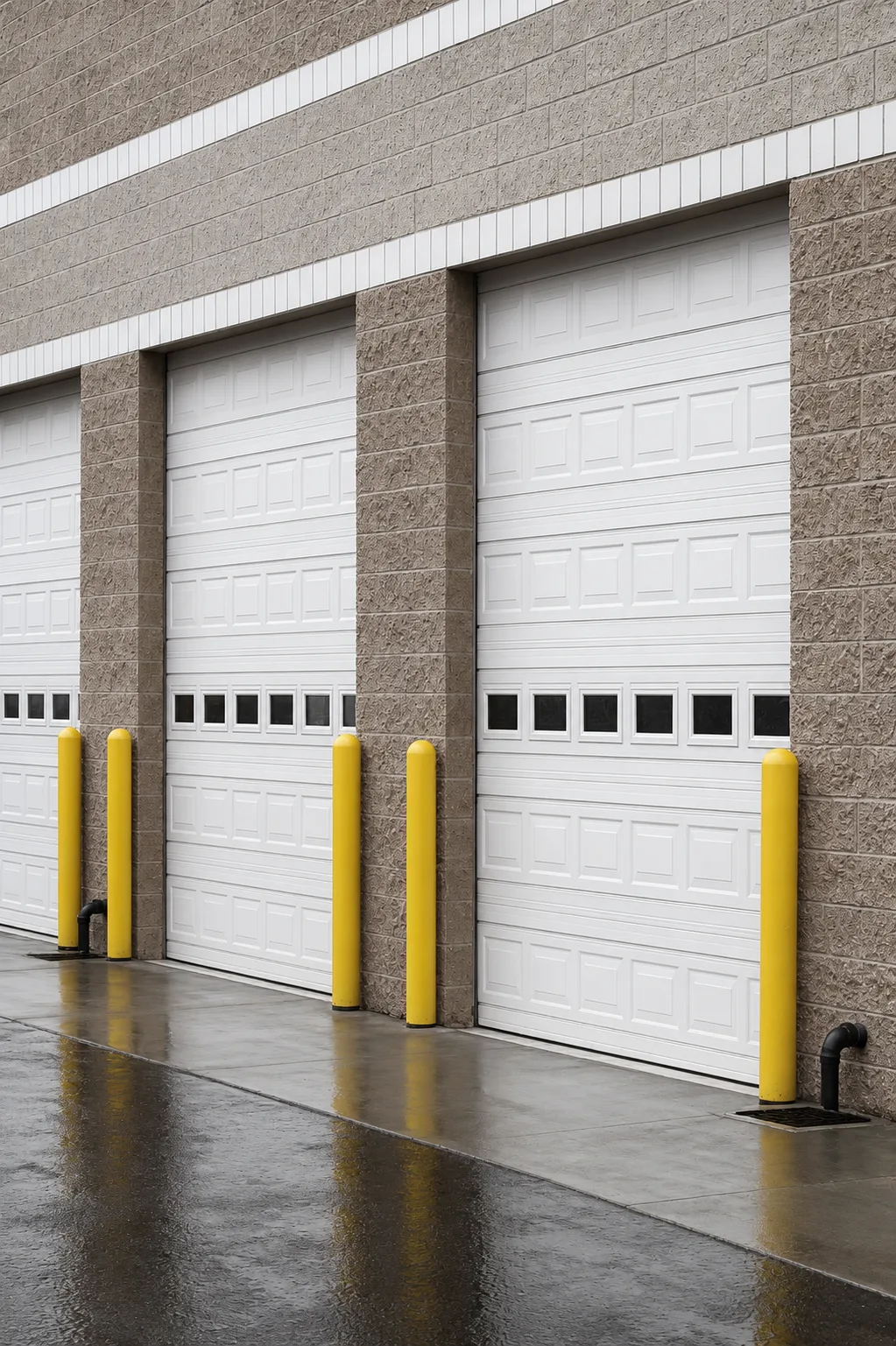
RHIDOOR’s new high-end remote-control garage door covers the smart features; fixing common garage door faults is the maintenance reference.
How to Size and Specify
Get the opening dimensions right and the rest follows. Our complete roller shutter size guide walks through width, height, headroom, and side room. Note the structural load — a wide steel shutter needs a reinforced lintel, exactly as a fire-rated one does.
Two specs decide comfort and durability once the door is hung. Insulation — a foam-filled double-wall curtain cuts heat transfer and outside noise, which matters for conditioned showrooms, offices, and any space people stand near. Wind load — exposed sites (coastal fronts, high-rise openings, flight paths) need a rated curtain and reinforced guides; our wind-resistant high-speed roller shutter advantages explains the rating. Get either wrong and the door rattles, leaks, or fails in the first storm.
Ready to see which door fits your opening? Explore RHIDOOR’s industrial door range →
Cost: What You Actually Pay
Sticker price is the smallest number in the total cost of ownership. Factor in:
- Unit cost — driven by material, size, and automation. What does a roller shutter usually cost? and the wholesale cost guide set the baseline.
- Motor & controls — a quality motor outlasts a cheap one many times over; cost to replace a roller shutter motor shows the downside of cutting corners.
- Installation & power — site wiring and structure prep.
- Maintenance — electric roller shutter care & maintenance and maintenance that extends roller shutter life keep the lifetime cost down.
- Freight & customs — a heavy steel order ships by volume, not just weight, and a wide door may need flat-rack container space. A light aluminum order packs denser and clears faster.
- Spares — stock the motor and a few slats locally so a failure is a same-day fix, not a three-week wait. RHIDOOR’s 1-piece MOQ means you can land a spare leaf or a replacement door without filling a container.
Story: A Nairobi retailer compared two quotes for his shopfront: a bare-bones steel shutter at $380 and an aluminum crystal shutter at $610. He almost took the steel — until he priced the repainting (rust within two years in coastal air) and the lost window displays. The crystal unit needed no repaint, kept his products lit at night, and cut theft attempts. Three years on, the “expensive” door was the cheaper one.
Choosing a Supplier
The same rules apply as for fire-rated doors: verify production, lead time, MOQ, and support. RHIDOOR ships from 1 piece, with a 15-day standard lead and 200+ RAL colors, which matters when you are fitting one store or prototyping a new model. Use four points when choosing a wholesale shutter maker and materials to consider before buying a roller shutter before you sign.
Story: A distributor in Accra took the lowest quote on 40 shopfront shutters from a maker who promised a 10-day lead. The doors arrived in week six, half the colors wrong, and the motors were a brand he could not service locally. He ate the delay and re-ordered the mismatched ones from RHIDOOR at a small premium — but with the right colors, a known motor, and a 15-day lead he could plan around. Cheapest quote, most expensive lesson.
Before you sign, tick four boxes: (1) can they show the workshop and QC records? (2) is the motor a serviceable global brand? (3) do they state lead time and MOQ in writing? (4) will they supply shop drawings before production? If a supplier hedges on any of these, the saving is not real.
Power-Outage Reality Check
Every powered door must work when the power does not. Know how to open an electric roller shutter during a power outage, what to do when a high-speed shutter will not start after an outage, and how to pair your roller shutter remote. A door that fails open or closed at the wrong moment is a door you will regret.
Quick Selection Cheat-Sheet
| If your opening is… | Start with this door |
|---|---|
| A busy dock or clean room | High-speed PVC (rolled or stacking) |
| A mall storefront you want lit | Crystal (transparent) shutter |
| A light-frame shop or coastal site | Aluminum roller shutter |
| A service yard or high-theft site | Steel roller shutter |
| A vehicle bay needing insulation | Sectional garage door |
| A retractable day/night barrier | Folding security gate |
Use the problem questions at the top of this guide to confirm the call, then follow the linked articles for the spec.
Conclusion
Choose the door from the problem: high-speed for throughput and climate, crystal for secure visibility, aluminum or steel for everyday shop and garage security, and sectional for vehicle access. Size it to the opening, budget by lifecycle, and buy from a maker who can ship a single unit fast and finish it in your color. RHIDOOR covers the full range — 1-piece MOQ, 15-day lead, 200+ RAL colors — with installation guidance from our engineers.
Get a tailored quote for your opening → Contact RHIDOOR and receive a specification within 48 hours.